Vocational skilling
Community-based training for young people and women outside the formal education cycle — a trade, plus the business skills to make the trade pay.
Training that comes to the community
Most of the people who need vocational training cannot reach a vocational institution. So the training goes to them: practical, employment-oriented, delivered inside their own community, in trades that the local economy is actually buying.
Tailoring and garment making. Hairdressing and barbering. Catering and baking. And alongside the skill itself, the part that most skilling programmes skip — how to start and run a small business, price the product, market yourself, and manage the money.
The objective is not a certificate. It is employability, self-employment, income, and a household that is measurably better off.
- Vocational and skills training
- Income-generating activities
- Savings groups
- Financial literacy training
- Targeted support for vulnerable and single mothers, and teenage mothers
Raising a young woman's household income is a separate focus area in the organisational profile. In practice it runs on the same rails as the skilling mandate, which is why the two sit together here.
What community-based actually looks like
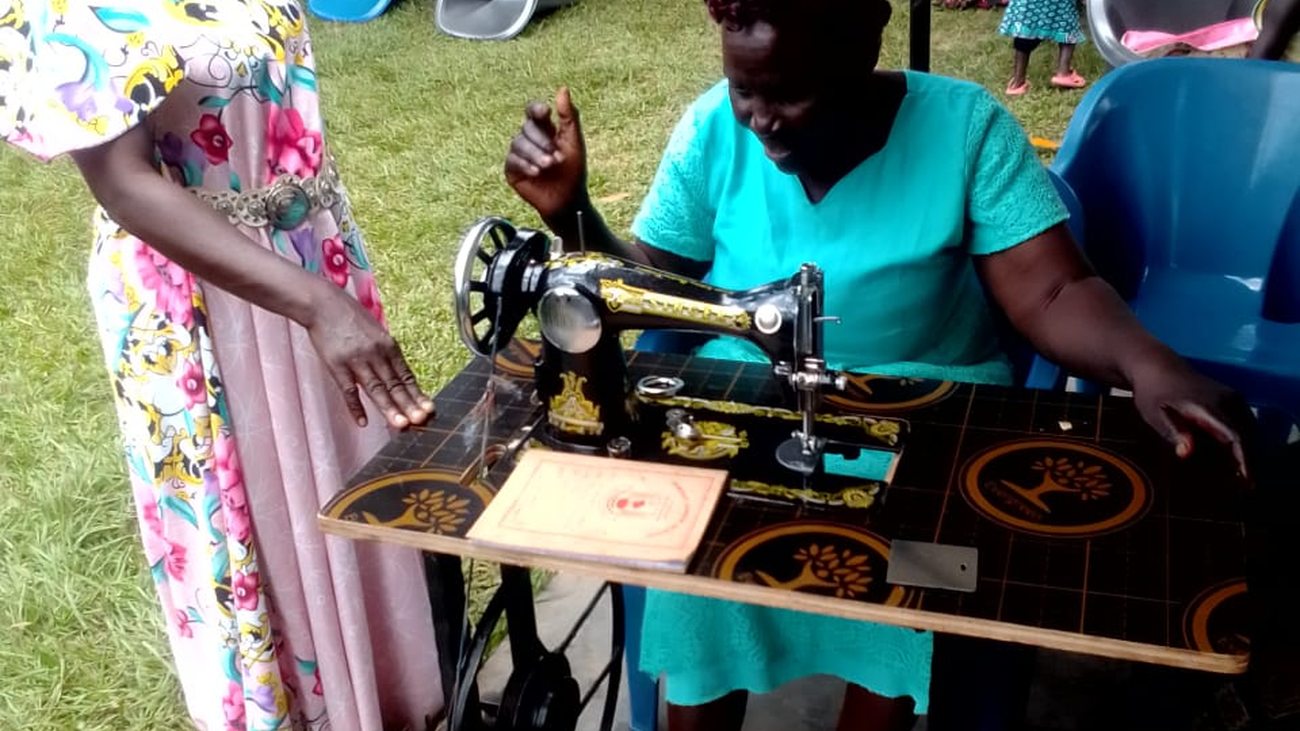
No workshop, no campus, no residential fees. A canopy, a row of machines or a line of chairs, a trainer who knows the trade, and learners who can walk home at the end of the day. That last part is the whole point — it is why a young mother can attend at all, and why in one of these photographs the trainer is working with her baby on her back.


Why this is an investment rather than a handout
It outlives the project
Rather than short-term assistance, beneficiaries are equipped to secure employment or start a business. The skill earns for years after the funding stops.
It matches supply to demand
These communities have a large young population and few jobs — and at the same time real demand for construction, tailoring, hairdressing, welding, mechanics, catering, agriculture and digital services. We connect the two, turning an unemployment problem into a productive resource.
It is countable, and it scales
Number trained, number certified, number employed, businesses established, income generated, jobs created. A model that works in one community can be replicated in the next, so the same investment reaches more people over time.
It moves vulnerable young people from dependency to productivity.
From the Les Flammes Africa organisational profile
Whether cohorts sit a DIT assessment or receive an internal certificate is not stated in the material we hold. It materially affects employability and should be confirmed.
Not yet published. Duration, contact hours and the intake calendar should appear here.
A tailoring graduate without a machine is not a tailor. Whether the programme includes a start-up kit, a loan, or a savings-group route to one should be stated plainly.
Fund a cohort
Skilling is the mandate with the clearest arithmetic: people trained, people employed, income generated. Ask us for the numbers and we will send what we have.